

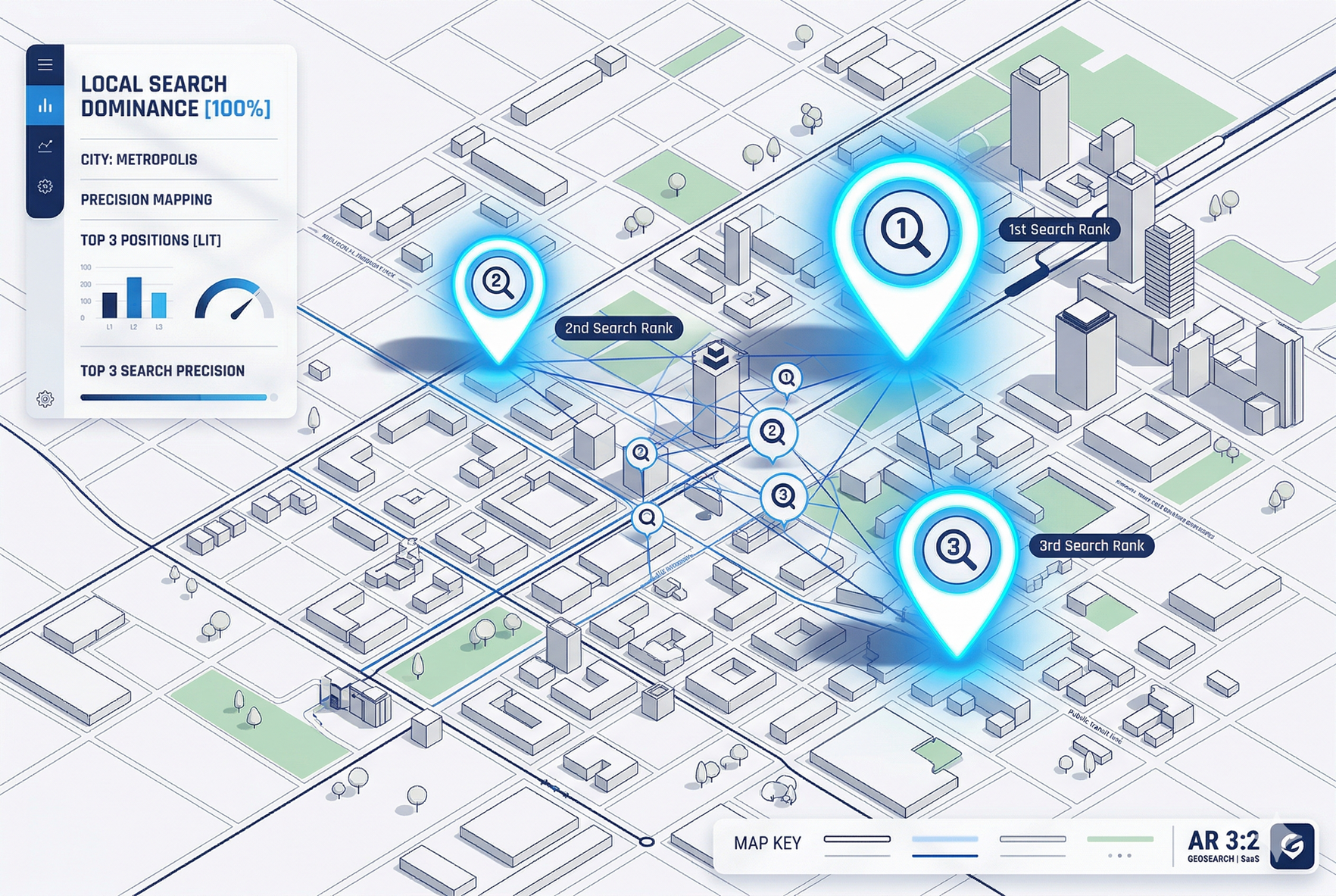
If your business is not in the "Top 3" of the Google Map Pack, you are effectively invisible to 46% of all local searchers. In the Upstate market—where competition for high-ticket services like Foundation Repair or Law Firms is at an all-time high—being #4 might as well be Page 10.
The Geometry of the Map Pack
Google doesn't just rank businesses based on who is closest to the searcher. The "Map Pack Blueprint" relies on a trifecta of signals: Relevance, Distance, and Prominence.
- Relevance: Does your Google Business Profile (GBP) clearly state exactly what you do? We see many businesses fail because they use generic categories. If you are a Luxury Remodeler in Spartanburg, your profile must be surgically tuned to those high-value keywords, supported by consistent "Services" updates.
- Distance: While you can’t change your physical location, you can signal your service area authority through "Geographic Trust Signals." Posting photos of completed jobs in Taylors, Travelers Rest, or Powdersville tells Google's algorithm that your authority extends across the corridor.
- Prominence: This is where most local agencies fall short. Google looks at your "Technical Search Health" via Search Console and your "Sentiment Velocity" (how fast you are getting high-quality reviews).
The Technical Advantage
A major part of our blueprint involves syncing your website's technical performance with your Map listing. If your site is slow or lacks "Schema Markup" (code that tells Google who you are), your Map ranking will suffer. By fixing these technical leaks, we often see businesses jump from Page 2 to the Top 3 in as little as 60 days.
Turning Maps into Revenue
The goal of ranking in the Map Pack isn't just about the "pin." It’s about being the most convenient and trusted choice for a customer who needs your help right now. When you combine a Top 3 position with a high volume of 5-star reviews, you create a lead-generation machine that operates 24/7.